
- Home
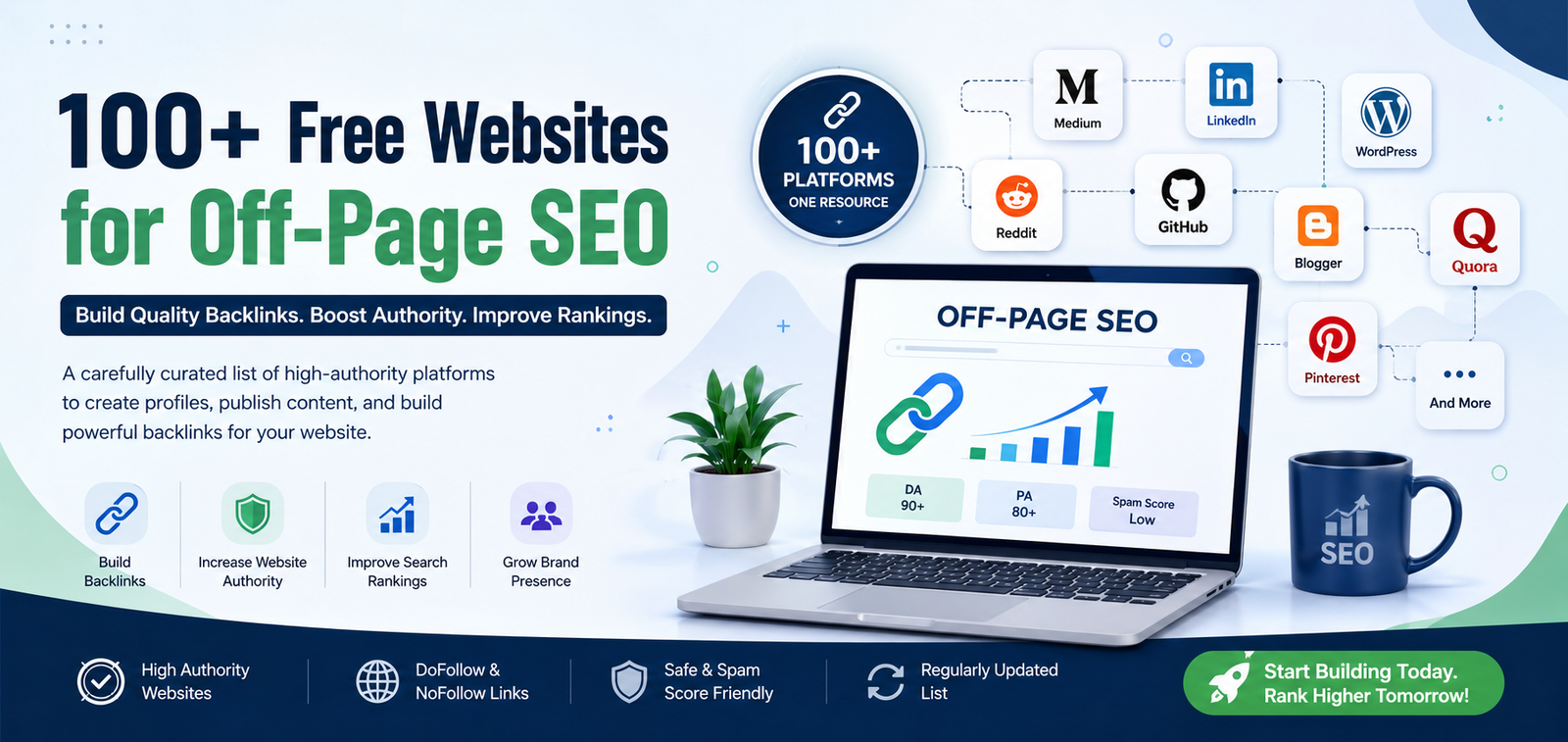
- Free Off-Page SEO Websites for Link Building: 100+ Platforms & Best Practices
Free Off-Page SEO Websites for Link Building: 100+ Platforms & Best Practices
A Practical Off-Page SEO Resource for Digital Marketing Students, SEO Beginners and Professionals
Off-Page SEO is an important part of a complete search engine optimisation strategy. While On-Page SEO focuses on optimising the content and structure of your own website, Off-Page SEO focuses on activities outside your website that can contribute to its visibility, authority, reputation and relevance.
One of the most commonly discussed areas of Off-Page SEO is link building.
A relevant backlink from another website can help search engines discover and understand your website and can potentially contribute to its authority. However, successful Off-Page SEO is not simply about collecting as many backlinks as possible. The quality, relevance, context and overall trustworthiness of the websites and content involved are important.
This resource provides a continuously updated collection of free websites and platforms that can be useful for profile creation, content publishing, blogging, community participation, website creation and other Off-Page SEO activities.
What is Off-Page SEO?
Off-Page SEO refers to activities performed outside your own website to improve its online presence and visibility.
Common Off-Page SEO activities include:
Link building
Digital PR
Brand mentions
Content distribution
Business citations
Profile creation
Community participation
Guest contributions
Reviews and reputation building
Social media visibility
Content publishing on relevant third-party platforms
Among these activities, backlinks remain an important part of many SEO strategies.
However, Off-Page SEO should not be treated as a backlink-only strategy.
A strong SEO campaign usually combines:Technical SEO + On-Page SEO + High-Quality Content + Off-Page SEO + User Experience + Brand Building
Free Off-Page SEO Websites
The following platforms can be explored for different Off-Page SEO activities. Their features, link attributes, authority metrics and publishing policies may change over time.
| # | Website | URL | Type | DA | PA | Spam Score | Link Type | Notes |
|---|---|---|---|---|---|---|---|---|
| 1 | Medium | medium.com | Blogging Platform | 90+ | DoFollow | Create profile + publish articles | ||
| 2 | linkedin.com | Professional Network | 90+ | NoFollow | Profile link + articles | |||
| 3 | GitHub | github.com | Code Repository | 90+ | NoFollow | Profile bio + README links | ||
| 4 | reddit.com | Forum / Community | 90+ | NoFollow | Profile + subreddit posts | |||
| 5 | pinterest.com | Image Sharing | 90+ | NoFollow | Pin descriptions + profile | |||
| 6 | Quora | quora.com | Q&A Platform | 90+ | NoFollow | Answer questions with links | ||
| 7 | WordPress.com | wordpress.com | Blogging Platform | 90+ | Mix | Free blog with links | ||
| 8 | Blogger | blogger.com | Blogging Platform | 90+ | Mix | Free blog on Google platform | ||
| 9 | Tumblr | tumblr.com | Blogging Platform | 85+ | NoFollow | Create free blog posts | ||
| 10 | About.me | about.me | Profile Page | 85+ | DoFollow | Personal landing page with link | ||
| 11 | Weebly | weebly.com | Website Builder | 85+ | Mix | Free website with backlink | ||
| 12 | Wix | wix.com | Website Builder | 90+ | Mix | Free site builder | ||
| 13 | Strikingly | strikingly.com | Website Builder | 80+ | Mix | One-page site builder | ||
| 14 | Sites.Google.com | sites.google.com | Website Builder | 90+ | NoFollow | Free Google Sites | ||
| 15 | Jimdo | jimdo.com | Website Builder | 80+ | Mix | Free website with link | ||
| 16 | Yola | yola.com | Website Builder | 70+ | Mix | Free website builder | ||
| 17 | Webnode | webnode.com | Website Builder | 75+ | Mix | Free site with link | ||
| 18 | Ghost (hosted) | ghost.org | Blogging Platform | 75+ | DoFollow | Modern blogging platform | ||
| 19 | Telegraph | telegra.ph | Instant Publishing | 85+ | DoFollow | Quick anonymous publishing | ||
| 20 | LiveJournal | livejournal.com | Blogging Platform | 85+ | Mix | Classic blogging platform | ||
| 21 | Google Business Profile | business.google.com | Business Directory | 90+ | NoFollow | Essential for local SEO | ||
| 22 | Yelp | yelp.com | Business Directory | 90+ | NoFollow | Business listing + website link | ||
| 23 | Bing Places | bingplaces.com | Business Directory | 90+ | NoFollow | Microsoft business listing | ||
| 24 | Yellow Pages | yellowpages.com | Business Directory | 85+ | NoFollow | Online business directory | ||
| 25 | Foursquare | foursquare.com | Business Directory | 85+ | NoFollow | Location-based listing | ||
| 26 | Manta | manta.com | Business Directory | 70+ | NoFollow | Small business directory | ||
| 27 | Hotfrog | hotfrog.com | Business Directory | 60+ | DoFollow | Global business directory | ||
| 28 | Spoke | spoke.com | Business Directory | 60+ | NoFollow | Company profiles directory | ||
| 29 | Brownbook | brownbook.net | Business Directory | 60+ | DoFollow | Global business listing | ||
| 30 | Cylex | cylex.com | Business Directory | 55+ | DoFollow | Business listing site | ||
| 31 | Mix.com | mix.com | Social Bookmarking | 70+ | NoFollow | Successor to StumbleUpon | ||
| 32 | Diigo | diigo.com | Social Bookmarking | 80+ | NoFollow | Bookmark and annotate | ||
| 33 | Folkd | folkd.com | Social Bookmarking | 55+ | DoFollow | Social bookmarking site | ||
| 34 | Slashdot | slashdot.org | Tech News / Bookmarking | 80+ | NoFollow | Tech community links | ||
| 35 | Scoop.it | scoop.it | Content Curation | 85+ | Mix | Curate and share content | ||
| 36 | flipboard.com | Content Aggregator | 85+ | NoFollow | Create magazines with links | |||
| 37 | Pearltrees | pearltrees.com | Content Curation | 75+ | Mix | Organize and share links | ||
| 38 | Instapaper | instapaper.com | Bookmarking | 80+ | NoFollow | Save articles for later | ||
| 39 | getpocket.com | Bookmarking | 85+ | NoFollow | Save and share links | |||
| 40 | Papaly | papaly.com | Social Bookmarking | 50+ | DoFollow | Bookmark organizer | ||
| 41 | Stack Overflow | stackoverflow.com | Q&A Forum | 90+ | NoFollow | Tech Q&A with profile link | ||
| 42 | Hackernoon | hackernoon.com | Tech Blogging | 80+ | DoFollow | Publish tech articles | ||
| 43 | Dev.to | dev.to | Developer Community | 80+ | NoFollow | Developer blogging platform | ||
| 44 | Indie Hackers | indiehackers.com | Startup Community | 65+ | NoFollow | Startup community posts | ||
| 45 | Warrior Forum | warriorforum.com | Marketing Forum | 70+ | Mix | Internet marketing forum | ||
| 46 | Digital Point | digitalpoint.com | Webmaster Forum | 65+ | NoFollow | Webmaster & SEO forum | ||
| 47 | SitePoint | sitepoint.com | Web Dev Community | 80+ | NoFollow | Community forum + profile | ||
| 48 | V7N Forum | v7n.com | Webmaster Forum | 50+ | DoFollow | SEO & webmaster forum | ||
| 49 | Behance | behance.net | Design Community | 90+ | NoFollow | Portfolio with website link | ||
| 50 | Dribbble | dribbble.com | Design Community | 85+ | NoFollow | Designer portfolio + link | ||
| 51 | EzineArticles | ezinearticles.com | Article Directory | 75+ | DoFollow | Submit articles with bio link | ||
| 52 | HubPages | hubpages.com | Article Platform | 80+ | Mix | Publish long-form articles | ||
| 53 | ArticleBiz | articlebiz.com | Article Directory | 45+ | DoFollow | Submit articles free | ||
| 54 | SelfGrowth | selfgrowth.com | Article Directory | 70+ | DoFollow | Self-improvement articles | ||
| 55 | GoArticles | goarticles.com | Article Directory | 50+ | DoFollow | General article submission | ||
| 56 | Vocal Media | vocal.media | Content Platform | 70+ | DoFollow | Publish stories and articles | ||
| 57 | Substack | substack.com | Newsletter Platform | 85+ | DoFollow | Free newsletter with links | ||
| 58 | Hashnode | hashnode.com | Tech Blogging | 75+ | DoFollow | Developer blog platform | ||
| 59 | Tealfeed | tealfeed.com | Content Platform | 50+ | DoFollow | Publish and share content | ||
| 60 | NewsBreak | newsbreak.com | News Platform | 75+ | Mix | Local news contributor | ||
| 61 | SlideShare | slideshare.net | Slide Sharing | 90+ | NoFollow | Upload presentations | ||
| 62 | Issuu | issuu.com | Document Sharing | 85+ | NoFollow | Publish digital documents | ||
| 63 | Scribd | scribd.com | Document Sharing | 85+ | NoFollow | Upload documents with link | ||
| 64 | Slideshare | slideshare.net | Slide Sharing | 90+ | NoFollow | Upload slides with links | ||
| 65 | Edocr | edocr.com | Document Sharing | 55+ | DoFollow | Share documents online | ||
| 66 | Calameo | calameo.com | Publishing Platform | 80+ | NoFollow | Digital publishing tool | ||
| 67 | Flickr | flickr.com | Image Sharing | 90+ | NoFollow | Photo descriptions + profile | ||
| 68 | Imgur | imgur.com | Image Sharing | 85+ | NoFollow | Image descriptions + link | ||
| 69 | 500px | 500px.com | Photography | 85+ | NoFollow | Photographer profile + link | ||
| 70 | YouTube | youtube.com | Video Sharing | 90+ | NoFollow | Video descriptions + channel | ||
| 71 | Vimeo | vimeo.com | Video Sharing | 90+ | NoFollow | Video descriptions + profile | ||
| 72 | Dailymotion | dailymotion.com | Video Sharing | 85+ | NoFollow | Upload videos with links | ||
| 73 | DeviantArt | deviantart.com | Art Community | 85+ | NoFollow | Artist profile with link | ||
| 74 | Loom | loom.com | Video Sharing | 80+ | NoFollow | Share videos with links | ||
| 75 | Wikipedia | wikipedia.org | Encyclopedia | 90+ | NoFollow | Requires notability; citation links | ||
| 76 | WikiHow | wikihow.com | How-to Wiki | 90+ | NoFollow | Contribute how-to guides | ||
| 77 | Fandom | fandom.com | Wiki Platform | 85+ | NoFollow | Create/edit wiki pages | ||
| 78 | Craigslist | craigslist.org | Classifieds | 85+ | NoFollow | Post ads with website link | ||
| 79 | OLX | olx.com | Classifieds | 75+ | NoFollow | Post listings with link | ||
| 80 | Gumtree | gumtree.com | Classifieds | 75+ | NoFollow | UK/AU classifieds | ||
| 81 | ClassifiedAds | classifiedads.com | Classifieds | 60+ | Mix | Free classified ad posting | ||
| 82 | PRLog | prlog.org | Press Release | 70+ | DoFollow | Free press release distribution | ||
| 83 | OpenPR | openpr.com | Press Release | 65+ | DoFollow | Free press releases | ||
| 84 | PR.com | pr.com | Press Release | 70+ | Mix | Free press release site | ||
| 85 | Visual.ly | visual.ly | Infographic Sharing | 75+ | DoFollow | Share infographics | ||
| 86 | Infographic Journal | infographicjournal.com | Infographic Sharing | 50+ | DoFollow | Submit infographics | ||
| 87 | Trustpilot | trustpilot.com | Review Platform | 90+ | NoFollow | Claim business page + link | ||
| 88 | G2 | g2.com | Software Reviews | 85+ | NoFollow | List software products | ||
| 89 | Capterra | capterra.com | Software Reviews | 80+ | NoFollow | List SaaS products | ||
| 90 | Product Hunt | producthunt.com | Product Launch | 85+ | DoFollow | Launch products with link | ||
| 91 | AlternativeTo | alternativeto.net | Software Directory | 75+ | NoFollow | Add software alternatives | ||
| 92 | Gravatar | gravatar.com | Profile Service | 85+ | NoFollow | Global avatar + profile link | ||
| 93 | IFTTT | ifttt.com | Automation Platform | 85+ | NoFollow | Profile with website link | ||
| 94 | Trello (Public Boards) | trello.com | Project Management | 85+ | NoFollow | Public boards with links | ||
| 95 | Notion (Public Pages) | notion.so | Productivity | 85+ | NoFollow | Public pages with links | ||
| 96 | Linktree | linktr.ee | Link in Bio | 80+ | DoFollow | Bio link page | ||
| 97 | Bit.ly | bit.ly | URL Shortener | 85+ | NoFollow | Shortened links with stats | ||
| 98 | Meetup | meetup.com | Event Platform | 85+ | NoFollow | Group pages with links | ||
| 99 | AngelList | angel.co | Startup Directory | 85+ | DoFollow | Startup profile with link | ||
| 100 | Crunchbase | crunchbase.com | Business Database | 85+ | NoFollow | Company profile with link |
Note: DA, PA and Spam Score are third-party SEO metrics and can change over time. Link attributes and platform policies may also change. Verify current values before using any platform.
DA, PA and Spam Score : What Do They Mean?
When evaluating websites for link building, SEO professionals often look at third-party metrics such as Domain Authority (DA), Page Authority (PA) and Spam Score.
Domain Authority (DA)
Domain Authority is a third-party metric developed by Moz that estimates the ranking strength of an entire domain.
A higher DA can indicate that a domain has stronger authority signals according to Moz’s methodology.
However, DA is not a Google ranking score.
Google does not use Moz’s DA score as a direct ranking factor.
Page Authority (PA)
Page Authority is another Moz metric that estimates the ranking strength of an individual webpage.
A website may have a high DA while a particular page on that website has a very different PA.
Therefore, looking at only the domain-level metric may not provide the complete picture.
Spam Score
Spam Score is a third-party metric designed to estimate how similar a website’s characteristics are to patterns associated with potentially spammy websites.
A high Spam Score does not automatically mean that every link from that website is harmful.
Likewise, a low Spam Score does not automatically make a website a high-quality backlink source.
These metrics should be treated as supporting indicators rather than absolute SEO decisions.
Why Do SEO Metrics Keep Changing?
A common mistake when creating backlink lists is assuming that metrics such as DA, PA and Spam Score are permanent.
They are not.
Website authority can change because of:
- New backlinks
- Lost backlinks
- Changes in the website’s link profile
- Changes in third-party SEO databases
- Search engine algorithm updates
- Domain changes
- Website restructuring
- Changes in indexing
- Changes in platform policies
- Changes in spam detection systems
For this reason, an SEO resource containing authority metrics should ideally be reviewed and updated periodically.
The same applies to link attributes.
A platform that provides a particular type of link today may change its linking policy tomorrow.
DoFollow vs NoFollow Links
Backlinks are often classified as DoFollow or NoFollow, although modern link attributes are more nuanced than this simple distinction.
A traditional DoFollow link can allow search engine crawlers to follow the link and may pass ranking signals.
A NoFollow link includes an attribute indicating that the publisher does not want the link treated as a normal editorial endorsement.
There are also other attributes such as:
rel="sponsored"rel="ugc"
The exact treatment of links depends on the search engine and the context.
Therefore, NoFollow does not mean “useless.”
NoFollow and other non-standard link attributes can still provide:
- Referral traffic
- Brand exposure
- Content discovery
- Audience visibility
- Potential secondary opportunities
- Brand mentions
- Community engagement
A natural backlink profile can contain different types of links.
Don’t Focus Only on DoFollow Links
One of the biggest misconceptions among beginners is:
“Only DoFollow backlinks are useful.”
SEO should not be approached that way.
If a website naturally receives attention from different sources, its backlink profile may include:
- Followed links
- NoFollow links
- UGC links
- Sponsored links
- Brand mentions
- Editorial links
- Directory references
- Social references
The objective should be to build a natural and relevant online presence, rather than artificially collecting only one type of link.
How to Use Free Backlink Platforms Properly
Free platforms can be useful, but the way they are used matters.
Creating an empty profile simply to place a backlink provides very little value.
Instead, create a complete profile and provide useful information.
For example:
On a professional profile platform
Add:
- Real name or business name
- Professional description
- Relevant expertise
- Website
- Social profiles
- Portfolio or projects
On a blogging platform
Publish:
- Original articles
- Practical guides
- Tutorials
- Case studies
- Research-based content
- Industry insights
On a Q&A platform
Provide:
- Genuine answers
- Useful explanations
- Examples
- Supporting resources
A link should be included only when it adds value to the reader.
Should You Publish the Same Article Everywhere?
Publishing exactly the same article across dozens of platforms is generally not the best content distribution strategy.
Instead, create unique or substantially adapted content for each platform.
For example, if your main website has an article titled:
“Complete Guide to Local SEO for Small Businesses”
you could create related but distinct content such as:
Medium
7 Local SEO Mistakes Small Businesses Should Avoid
What Small Businesses Should Know About Local Search Visibility
Quora
How Can a Small Business Improve Its Local Google Visibility?
Create an infographic:
Local SEO Checklist for Small Businesses
Participate in an existing relevant discussion and provide a genuinely useful answer.
This approach allows one core topic to become multiple useful content assets without simply copying and pasting the same article everywhere.
Write for People First
Good SEO content should be written primarily for people.
Avoid writing content that exists only to insert keywords or backlinks.
Instead:
- Answer the searcher’s question
- Use simple language
- Explain concepts clearly
- Provide examples
- Add useful statistics or references where appropriate
- Include relevant visuals
- Use descriptive headings
- Keep paragraphs readable
- Avoid unnecessary repetition
For example, instead of repeatedly using:
“best off-page SEO techniques, off-page SEO backlinks, off-page SEO link building…”
write naturally:
“Backlinks are one part of Off-Page SEO, but the relevance and context of the link are often more important than simply increasing the number of links.”
This creates a better experience for both readers and search engines.
Avoid Keyword Stuffing
Keywords still have an important role in SEO, but excessive repetition can make content difficult to read.
Use your primary keyword naturally.
For an article about Off-Page SEO, related terms may include:
- Off-Page SEO
- Link Building
- Backlinks
- SEO Strategy
- Content Marketing
- Digital PR
- Website Authority
- Link Building Strategy
- Brand Mentions
- SEO Content
Use these terms where they genuinely fit the topic.
Do not force keywords into every paragraph.
E-E-A-T and Off-Page SEO Content
High-quality content should demonstrate Experience, Expertise, Authoritativeness and Trustworthiness (E-E-A-T).
This can be supported by:
- Sharing first-hand experience
- Providing practical examples
- Using credible sources
- Linking to authoritative references
- Keeping information updated
- Clearly identifying the author
- Avoiding unsupported claims
- Correcting outdated information
For example, instead of claiming:
“This website will definitely improve your Google rankings.”
a more responsible statement would be:
“This platform may be useful for content distribution, profile visibility or link building, but a backlink from the platform does not guarantee higher Google rankings.”
This distinction is important when creating professional SEO resources.
How Many Links Should an Article Have?
There is no universal number of links that every article should contain.
The correct number depends on the purpose and length of the content.
The basic principle is:
Add a link when the link is genuinely useful to the reader.
Your article might need one relevant link, or it might need several.
Avoid adding links simply because there is an opportunity to do so.
Internal links can help readers discover related content on your website.
External links can provide supporting information from authoritative and relevant sources.
Both can be valuable when used naturally.
Use Relevant Images and Visual Content
Images can make an educational SEO article easier to understand.
Depending on the topic, you can use:
- Infographics
- Screenshots
- Charts
- Diagrams
- Original photographs
- Illustrations
- AI-generated visuals
- Process diagrams
If AI-generated images are used, they should still be reviewed and edited before publication.
Make sure the image is:
- Relevant to the topic
- Visually clear
- Free from unnecessary text
- Properly compressed
- Correctly formatted
- Accessible with descriptive ALT text
The goal is not to add an image simply because every blog needs one.
The image should improve the content.
Different Types of SEO Blogs You Can Create
A strong SEO content strategy should include different content formats.
1. How-To Guides
Example:
How to Build an Off-Page SEO Strategy Step by Step
Useful for people looking for practical instructions.
2. Informational Articles
Example:
What Is Off-Page SEO?
Useful for beginners researching a topic.
3. List Articles
Example:
50 Free Websites for SEO Link Building
Useful as a resource.
4. Case Studies
Example:
How a Local Business Improved Its Online Visibility
Useful for demonstrating real-world experience.
5. Comparison Articles
Example:
On-Page SEO vs Off-Page SEO: What’s the Difference?
Useful for people comparing concepts.
6. Checklists
Example:
Complete Off-Page SEO Checklist for Beginners
Useful for practical implementation.
7. Mistake-Based Articles
Example:
10 Common Link Building Mistakes to Avoid
Useful for problem-solving search intent.
8. Beginner’s Guides
Example:
Off-Page SEO: A Complete Beginner’s Guide
Useful for broad educational searches.
Don’t Build 100 Backlinks in One Day
A long list of websites does not mean that all of them should be used immediately.
If you discover 100+ platforms, there is no need to create 100 profiles and publish 100 links in a single day.
SEO is a long-term process.
Focus on:
Relevance → Quality → Consistency → Measurement → Improvement
Instead of:
Quantity → Quantity → Quantity
Build your online presence gradually.
Create useful content.
Participate in relevant platforms.
Build professional profiles.
Earn genuine mentions.
Publish valuable resources.
Monitor the results.
Then improve your strategy.
Quality Matters More Than Quantity
Imagine two websites.
Website A has hundreds of random backlinks from unrelated platforms.
Website B has fewer backlinks, but they are relevant, contextual and earned through useful content.
The number of links alone does not tell us which website has the stronger SEO strategy.
This is why modern link building should focus on:
- Relevance
- Context
- Quality
- Trust
- Editorial value
- Natural acquisition
- Referral potential
A backlink should ideally make sense even if search engines did not exist.
Ask:
Would a real person find this link useful?
If the answer is yes, you are more likely to be creating a meaningful resource.
Off-Page SEO Is More Than Link Building
Backlinks are important, but Off-Page SEO goes beyond links.
A broader Off-Page SEO strategy may include:
Link Building
Building relevant references from other websites.
Digital PR
Getting your business, expertise or content mentioned by publications and media.
Brand Mentions
Increasing awareness and references to your brand across the web.
Community Engagement
Participating genuinely in relevant online communities.
Reviews
Building trust and reputation through legitimate customer reviews.
Content Distribution
Getting useful content in front of relevant audiences.
Professional Profiles
Creating credible and consistent profiles across relevant platforms.
The objective is to build a stronger online presence and reputation, not simply a larger backlink count.
Keep This Resource Updated
SEO platforms and metrics are constantly changing.
A website that is available today may change its publishing policy tomorrow.
A link that is Follow today may become NoFollow later.
A website’s DA, PA or Spam Score can also change as third-party tools recalculate their databases.
Therefore, this list should be treated as a living SEO resource rather than a permanent database.
The platforms, metrics and link attributes should be reviewed periodically.
New platforms can be added, outdated platforms can be removed, and existing information can be updated.
Final Takeaway
Off-Page SEO is an important part of a complete SEO strategy, but successful link building is not about creating the maximum number of backlinks.
It is about creating the right content, on the right platforms, for the right audience, with relevant and natural references.
Free platforms such as blogging websites, professional networks, community platforms, Q&A websites, website builders and publishing platforms can provide useful opportunities for building content, visibility and online presence.
However, always evaluate a platform based on:
Relevance + Quality + Context + Trust + Current Data
Do not rely on DA, PA or Spam Score alone.
Do not focus only on DoFollow links.
Do not publish the same article everywhere.
Do not create links just for the sake of creating links.
Instead, create useful content, contribute genuinely, build your online presence gradually and keep your SEO resources updated.
The best Off-Page SEO strategy is not the one with the most links. It is the one that creates the most relevant and trustworthy signals around a website.
Free Off-Page SEO Resource List
This resource will be continuously updated with additional platforms, websites and SEO opportunities.
Check the current list before using any platform, as website policies, link attributes, authority metrics, spam scores and publishing options may change over time.

Sinu P Sabu
Digital Marketing Trainer, Mentor, Internship Instructor, Blogger
Join our Newsletter
Join a thousand professionals and become a better social media marketer. Get social media resources and tips in your inbox.